
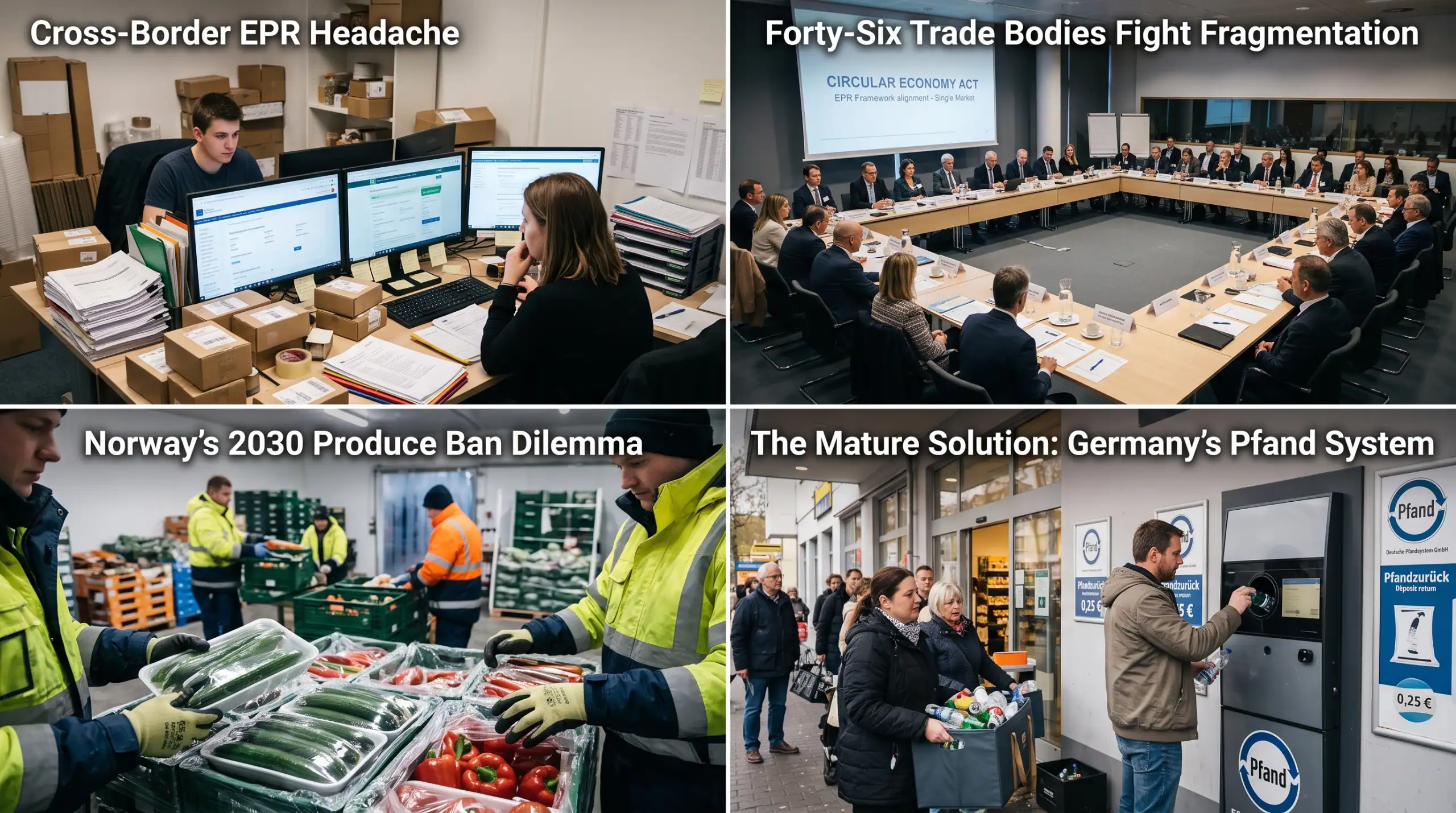
Ten weeks after the Packaging and Packaging Waste Regulation began applying across the EU, three separate disputes this month show where the rules are rubbing hardest: who has to appoint a representative to handle extended producer responsibility, whether 27 national EPR systems can ever work as one market, and whether a single-use plastic ban written for the whole bloc can survive contact with a cucumber in Tromsø. A fourth story, Germany’s long-running deposit scheme, is the quiet counterpoint: proof that a well-built system can work at scale.
Authorised representative relief moves through Parliament and Council
The PPWR’s EPR rules require many producers selling packaged goods across EU borders to register in each market and, in some cross-border situations, appoint an authorised representative under Article 45(3). For micro and small sellers without compliance teams, that has meant separate registrations, languages and portals in every country they ship to.
A European Parliament committee moved to ease that burden on 5 October 2026, with the proposal approved by the relevant parliamentary committee and a plenary vote to follow before negotiations begin with the European Council. That builds on the Commission’s own proposal, COM(2025) 982 of 10 December 2025, which would suspend the Article 45(3) obligation until 1 January 2035; as of this committee vote it remains a proposal, not adopted law.
Member states are pushing from the other side. On 8 October, Austria, backed by Czechia and Estonia, submitted a document to the Council ahead of its 12 October Environment Council meeting, calling for a proportionate EPR framework for small producers and the single market under the PPWR. Industry reaction is not unanimous: industry groups support a more proportionate system but disagree on whether exemptions should be based on company size or the volume of packaging. Tim Arlt, CEO of e-commerce association Händlerbund, told Packaging Insights that “while the suspension is still being negotiated, no obligation to appoint an authorized representative should apply.”
EuroCommerce, representing retail and wholesale, frames the problem as structural rather than a drafting error. According to the association, the implementation of authorized representative requirements has exposed significant differences between national EPR schemes and the waste legislation of the various member states. That observation connects directly to the second story this month: an industry push to fix the underlying fragmentation through the EU’s next circular economy law, not just patch one article of the PPWR.
Forty-six trade bodies want one EPR framework, not a patchwork
On 14 October, a coalition that includes CEFLEX, Plastics Europe, EUROPEN, INCPEN, Metal Packaging Europe and Steel for Packaging Europe published a joint statement on the forthcoming Circular Economy Act. The coalition of 46 trade associations is calling for the act to unite the bloc’s EPR schemes into an aligned and enforceable system. Their argument is that a competitive circular economy cannot be built on “fragmented national systems” and that the new law must provide “scale, trust and investment certainty.”
The timing matters for anyone running compliance budgets into 2027. The Circular Economy Act is due for adoption by the European Commission this year and aims to increase the supply and demand for high-quality recycled materials, with a target to double the EU’s current use of circular materials by 2030. If the act does move toward a directly applicable EU EPR regulation, as the coalition wants, it would sit alongside the PPWR rather than replace it, addressing the registration and representative headaches that are driving the Article 45(3) debate above.
For now this is advocacy, not legislation. Brand owners and converters should treat it as a signal of direction rather than a date to plan around; the Commission has not published draft text, and both the timing and the legal basis (whether grounded in the EU’s internal market powers under Article 114 TFEU, as the coalition wants) remain open questions.
Norway tests the limits of the Annex V produce ban
The PPWR’s Annex V restrictions sit in Article 25, and one of them bans single-use plastic packaging for fresh fruit and vegetables under 1.5 kilograms, the nets, bags and trays used for items like cucumbers and peppers. The EU’s packaging regulation, which came into force on 12 August 2026, prohibits single-use plastic packaging for fresh fruit and vegetables weighing less than 1.5 kg. The ban itself takes effect from 1 January 2030.
Norway is not an EU member but applies EU single market law through the EEA Agreement, and it is now asking for carve-outs before the rule lands domestically. Norway has until 2030 to comply, with implementation into Norwegian law scheduled for spring 2027. The country’s largest fresh produce supplier, Bama, is leading the pushback. Bama has raised concerns about the impact on shelf life and distribution, particularly in Northern Norway, where transport distances are longer, and research conducted with Nofima found that removing plastic film reduces cucumber shelf life by eleven days. Bama’s packaging director argues that cucumbers, bell peppers, and lettuce should qualify for exemptions based on their shelf-life requirements, and the company warns that removing plastic packaging could increase food waste, potentially offsetting the environmental benefits of reduced plastic consumption.
The regulation does leave room for this. National exemptions are permitted within Annex V, and the Commission is due to clarify how they work: it must publish guidelines on Annex V, including which fruits and vegetables are excluded from the restriction, by 12 February 2027. Until then, converters and retailers serving Nordic and other long-supply-chain markets face a genuine open question rather than a settled rule, and the Commission’s guidance deadline is the date to watch, not the 2030 ban itself.
The dispute is a preview of a pattern other member states will likely repeat: a bloc-wide rule written around shelf-stable produce in dense distribution networks, tested against the reality of longer, colder supply chains elsewhere in Europe.
Germany’s deposit scheme: what a mature system delivers
Set against the friction above, Germany’s deposit return scheme is a working example of EPR done well, and it is worth the comparison because it shows what the Circular Economy Act coalition is actually asking the rest of the EU to match.
Germany’s Pfandsystem, running since 2003 with a flat €0.25 deposit on single-use PET, metal and glass drink containers, delivers the highest beverage container recycling performance in Europe. For aluminium cans specifically, Germany achieves the highest recycling rate at 99 percent, closely followed by Belgium, Finland and Norway, while Cyprus remains the European laggard, with around 30 percent of aluminium beverage cans recycled. Across the wider region, the can recycling rate across the EU, UK, Switzerland, Norway and Iceland reached 76.3 percent in 2023, according to the joint report from Metal Packaging Europe and European Aluminium.

That spread, 99% in Germany against 30% in Cyprus, is the exact fragmentation the 46-association coalition points to when it argues for harmonised, enforceable EPR. A deposit scheme with a meaningful deposit value and a dense return network produces results; a collection system without one does not, regardless of what the PPWR’s national targets say on paper.
Where the PPWR is under strain right now
| Issue | Jurisdiction | Current status | Practical effect |
|---|---|---|---|
| Article 45(3) authorised representative suspension | EU | Commission proposal (COM(2025) 982); backed by a Parliament committee on 5 October 2026; plenary vote pending | Would pause the representative obligation for eligible cross-border sellers until 2035; registration and EPR fees would still apply |
| Proportionate EPR framework for small producers | EU Council (Austria, Czechia, Estonia) | Council position paper submitted 8 October 2026 | Pushes for a binding, EU-wide rule rather than a Commission recommendation |
| Harmonised EU EPR framework via Circular Economy Act | EU | Joint statement from 46 trade associations, 14 October 2026; Commission adoption of the act expected this year | Could eventually replace national EPR patchwork with one enforceable framework and a digital one-stop shop |
| Annex V single-use plastic ban for fresh produce under 1.5 kg | EU/EEA (Norway) | Ban effective 1 January 2030; Commission guidance on exemptions due 12 February 2027; Norway transposing by spring 2027 | Converters and growers need redesigned packaging or a confirmed national exemption before 2030 |
What to do now
- If your business relies on the Article 45(3) suspension to avoid appointing representatives, treat it as proposed, not confirmed, until the Parliament plenary and Council agree a final text; keep registration and EPR fee obligations current regardless.
- Track the Circular Economy Act’s draft text once published rather than planning around the current coalition statement; note whether it proposes a directly applicable EU EPR regulation or guidance for member states to implement.
- If you pack fresh produce under 1.5 kg for Nordic or other long-distribution markets, watch for the Commission’s Annex V guidelines due by 12 February 2027 before redesigning away from plastic film.
- Benchmark any national EPR or deposit scheme you operate under against Germany’s return rate and deposit structure; the gap between best and worst performers is now the central argument for EU-level reform.
- For binding detail on any of the above, check the official text in the Official Journal or Commission guidance, or take legal advice before committing capital to redesign.
Sources
- Source: EU weighs PPWR compliance relief as cross-border small businesses face costs – Packaging Insights
- Source: European Parliament moves forward with easing EPR rules for small businesses – Grande Consumo
- Source: EU circular economy law must harmonise EPR, say trade bodies – Packaging News
- Source: Norway seeks exemptions from EU plastic packaging ban for vegetables – FreshPlaza
- Source: EU plastic packaging ban raises concerns over vegetable supplies in Northern Norway – High North News
- Source: Europe recycles 76 percent of aluminum cans – Aluminium Exhibition
- Source: Europe secures 76.3% in aluminium can recycling, led by Germany with 99% – AL Circle