
The Packaging and Packaging Waste Regulation has applied across the EU since 12 August 2026. Two months on, this week’s developments show how much of the detail around it is still being argued over: who gets relief from a key administrative burden, how PFAS limits will actually be tested, and what buyers are now asking suppliers to put in writing.
Parliament narrows the EPR authorised-representative suspension to SMEs
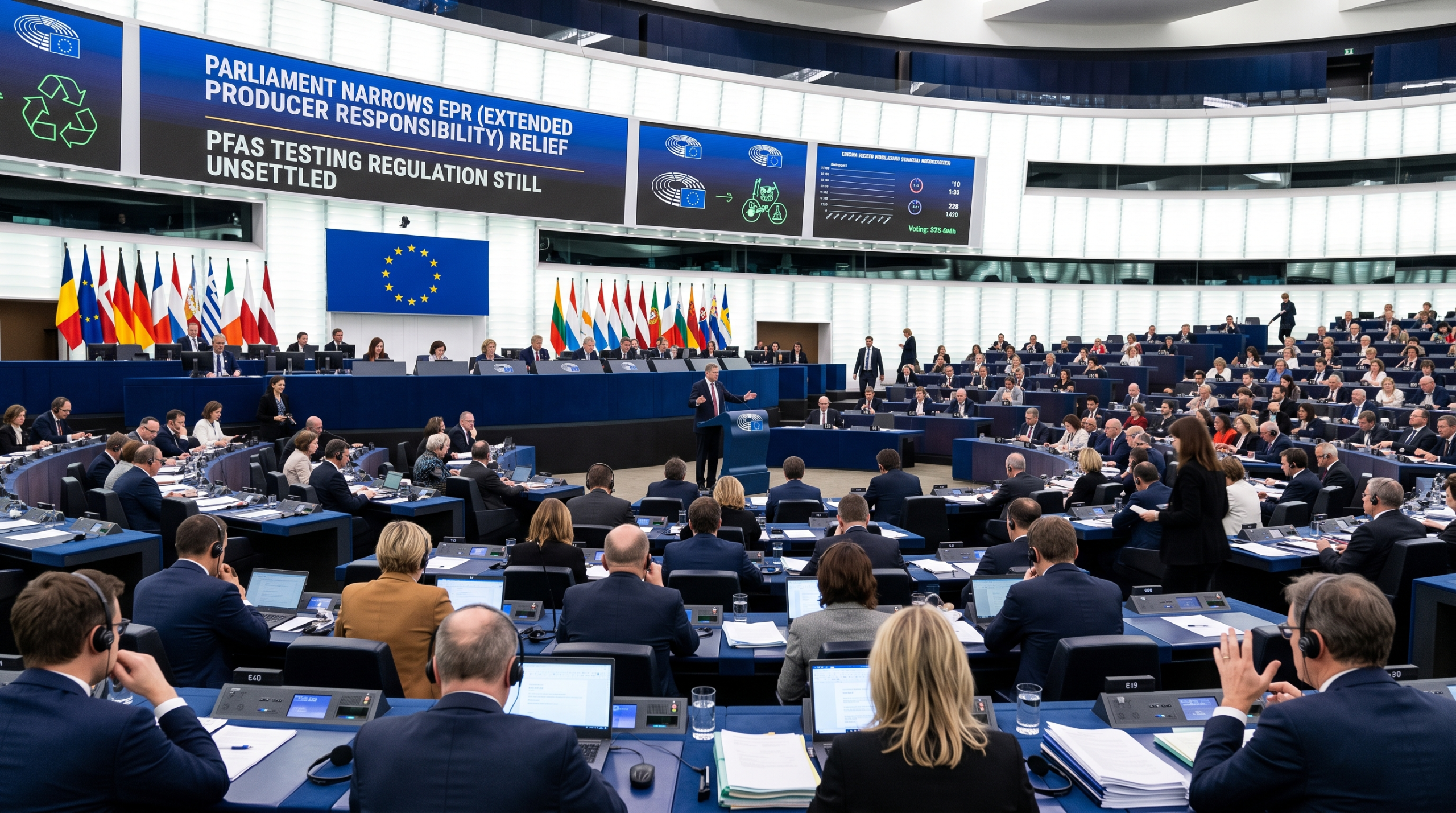
On 5 October, the European Parliament’s Committee on the Environment, Climate and Food Safety (ENVI) voted on its position regarding a Commission proposal to suspend the requirement for producers to appoint an authorised representative for extended producer responsibility in each member state where they sell packaging without being established there. On Monday 5 October, members of the European Parliament’s Committee on the Environment, Climate and Food Safety adopted a position regarding measures to simplify producer responsibility rules for batteries, packaging, textiles, footwear, electronic equipment and single-use plastics.
The Commission’s original proposal, COM(2025) 982 of 10 December 2025, was broader. The European Commission had proposed suspending until 2035 the requirement for producers to appoint an authorised representative for extended producer responsibility in each Member State. MEPs want something narrower. MEPs want to limit this suspension to SMEs established in the EU. The exact size threshold has been reported slightly differently across sources: EUWID and Packaging Insights describe the exemption as covering micro and small enterprises, which are defined under EU law as companies with fewer than 50 employees and annual turnover under €10m or an annual balance sheet total of no more than €10m, while Agence Europe’s account of the same vote puts the threshold at companies employing fewer than 250 people with an annual turnover of less than €50 million or an annual balance sheet total of less than €43 million. Readers who need the precise figure should check the adopted committee text once published, since these two descriptions do not match.
What is consistent across the reporting: non-EU producers keep the existing obligation. Companies established outside the EU would still have to appoint a representative. MEPs also want the relief to expire automatically rather than run indefinitely to 2035: MEPs also support the inclusion of a sunset clause that would automatically end the suspension once comprehensive rules on circularity enter into force. The committee’s position on the batteries and packaging file passed comfortably. The parliamentary committee’s position on batteries and packaging was supported by 74 MEPs, with no votes against and four abstentions.
This is not adopted law. The European Parliament’s Committee on the Environment, Climate and Food Safety voted on 5 October in favour of the proposal concerning authorised representative requirements for EU-based micro and small enterprises under batteries, packaging, textiles, footwear, electronics and single-use plastics EPR rules. A final plenary vote is expected before negotiations with the Council can begin. The Council has so far held back: EU governments agreed a negotiating position on other parts of the Environmental Omnibus in June but left the authorised-representative question open, reflecting what the Council itself called “strong reservations” expressed by a large majority of member states, alongside a preference to deal with it inside the forthcoming Circular Economy Act. EuroCommerce, representing retailers and wholesalers, has urged both sides to move. The sector urged the co-legislators to reach an agreement swiftly and give companies certainty over authorised representative requirements.
Not everyone welcomes a broader carve-out. European National Registers for Packaging has flagged a compliance risk: EUNR warns relaxing requirements could worsen free-riding and leave compliant producers covering packaging waste costs. For producers and compliance schemes, the practical point for now is that nothing has changed yet. The obligation under Article 45(3) stands until a regulation is adopted, and that requires a Parliament plenary vote, expected this month, followed by agreement with the Council.
| Aspect | Commission proposal (Dec 2025) | ENVI committee position (5 Oct 2026) |
|---|---|---|
| Who benefits | All EU-established producers | Narrowed to EU micro and small enterprises (reported thresholds vary; confirm against final text) |
| Non-EU producers | Still must appoint a representative | Unchanged: still must appoint a representative |
| Duration | Suspended until 1 January 2035 | Sunset clause tied to entry into force of future circularity rules (Circular Economy Act) |
| Status | Proposal only | Committee position adopted; plenary vote expected this month, then Council negotiation |
PFAS limits are in force, but the test method isn’t settled
The PFAS restriction in food-contact packaging has applied since 12 August 2026, with the thresholds already familiar to readers of this publication: 25 ppb for any single PFAS, 250 ppb for the sum of PFAS, and 50 ppm total fluorine. The National Law Review’s September PFAS update, published this week, points to an unresolved problem behind that deadline: there is still no agreed way to test for it. PPWR guidance on the harmonized sampling and testing of PFAS in food contact packaging remains elusive, despite the PFAS packaging restriction applying on 12 August 2026. The latest draft dates apparently from mid-July 2026.
Two member states are pushing back on the Commission’s draft approach. France and Sweden oppose the testing methods proposed by the Commission to measure PFAS in food contact packaging. In this context, the Commission is elaborating a harmonized measurement method. The press reports that France and Sweden are opposing a first draft proposed by the Commission. Both consider that the document can be improved.
For packaging engineers and compliance teams, this leaves an awkward gap. The ban itself is binary and already enforceable: non-compliant food-contact packaging cannot legally be placed on the EU market, and the Commission has said there is no stock-exhaustion period. What remains open is exactly which laboratory method, and whose interpretation of total fluorine versus total organic fluorine, a market surveillance authority will rely on if a result is disputed. Until a harmonised method is settled, documentation from accredited labs and a clear paper trail back to resin and ink suppliers is the safest position, even though the final test protocol could still shift.
Compliance evidence is now a procurement question
A second thread this week, reported by Environment+Energy Leader, is that PPWR compliance has moved out of the regulatory affairs file and into this quarter’s purchasing conversations. Any packaging a company buys for the European market this quarter already falls under the EU’s new packaging regulation, and the documents that prove it complies have to come from suppliers before national penalties arrive in February. Buyers who wait for the first fines to learn what inspectors want may find out with a shipment already sitting at the border.
The regulation’s reach is wide by design. The Packaging and Packaging Waste Regulation (PPWR), Regulation (EU) 2025/40, entered into force on February 11, 2025 and began applying in every member state on August 12, 2026, according to the European Commission. It replaces the 1994 packaging directive and covers all packaging placed on the EU market, wherever it was made, as the report notes, citing the law firm Faegre Drinker. The specific documents now showing up in supplier contracts are the ones tied to the obligations already in force: PFAS and heavy-metal test results, and the EU declaration of conformity with its supporting technical documentation. Food-contact packaging can no longer be sold in the EU if it holds per- and polyfluoroalkyl substances (PFAS) above 25 parts per billion for any single substance or 250 parts per billion combined. Lead, cadmium, mercury and hexavalent chromium are capped at 100 milligrams per kilogram. For procurement teams, the practical change is that these figures now belong in purchase order terms and supplier qualification checklists, not just in a compliance binder.
| Obligation | Who must act | Status as of October 2026 |
|---|---|---|
| PFAS limits in food-contact packaging | Manufacturers, importers, brand owners of food-contact packaging | In force since 12 Aug 2026; no stock-exhaustion period; harmonised test method still disputed between France, Sweden and the Commission |
| EU declaration of conformity and technical documentation | Manufacturers and importers placing packaging on the EU market | In force since 12 Aug 2026; increasingly requested as a contractual document by buyers ahead of national penalty regimes |
| Authorised representative for EPR (Article 45(3)) | Producers selling cross-border without local establishment | Still mandatory; ENVI-backed suspension for EU micro/small enterprises not yet adopted |
| Recycled content minimums, recyclability grades, empty-space ratio | Plastic packaging producers; grouped, transport and e-commerce packaging | From 1 January 2030, subject to outstanding implementing acts |
The recycled content curve ahead
Whatever happens to the authorised-representative suspension in the coming weeks, the dates that matter most for packaging design remain on the statute book unless the Commission formally proposes otherwise. The 2030 minimums for recycled content in plastic packaging roughly double by 2040, and the gap is biggest for single-use plastic beverage bottles and “other plastic packaging,” which both jump from 30-35% to 65%.

What to do now
- Treat the authorised-representative suspension as unconfirmed. If your business relies on it for 2027 planning, keep a fallback plan that assumes the current Article 45(3) obligation stays in place, and track the Parliament plenary vote expected this month.
- For food-contact packaging, don’t wait for the harmonised PFAS test method. Get Certificates of Analysis from accredited labs now, and ask suppliers which method they used so you can re-test if the Commission’s final protocol differs.
- Add PPWR conformity documents, PFAS data and the EU declaration of conformity to supplier qualification and contract templates this quarter, ahead of national penalty regimes due in February.
- Map which of your SKUs fall under contact-sensitive PET, contact-sensitive non-PET, single-use beverage bottles or “other plastic packaging” now, since the recycled content step-up from 2030 to 2040 is steepest for the last two categories.
- This article is informational and not legal advice. Check the official text of Regulation (EU) 2025/40 and the ENVI committee’s adopted reports, or take legal advice, before relying on any of the dates above for contractual commitments.
Sources
- Source: New EU rules on packaging enter into application – European Commission
- Source: Legislative train – Authorised representative for EPR – European Parliament
- Source: MEPs ease rules on extended producer responsibility (EPR) – Agence Europe
- Source: EP Environment Committee backs narrower exemption from EPR representative rules – EUWID
- Source: EU Parliament committee backs EPR reprieve for pack SMEs – Packaging Insights
- Source: First step in the right direction – EuroCommerce
- Source: EU countries voice “strong reservations” over scrapping EPR authorised representative requirement – EUWID
- Source: Latest Updates on Per- and Polyfluorinated Substances (PFAS) – September update – The National Law Review
- Source: Europe’s Packaging Regulation Now Reaches Supplier Contracts – Environment+Energy Leader